
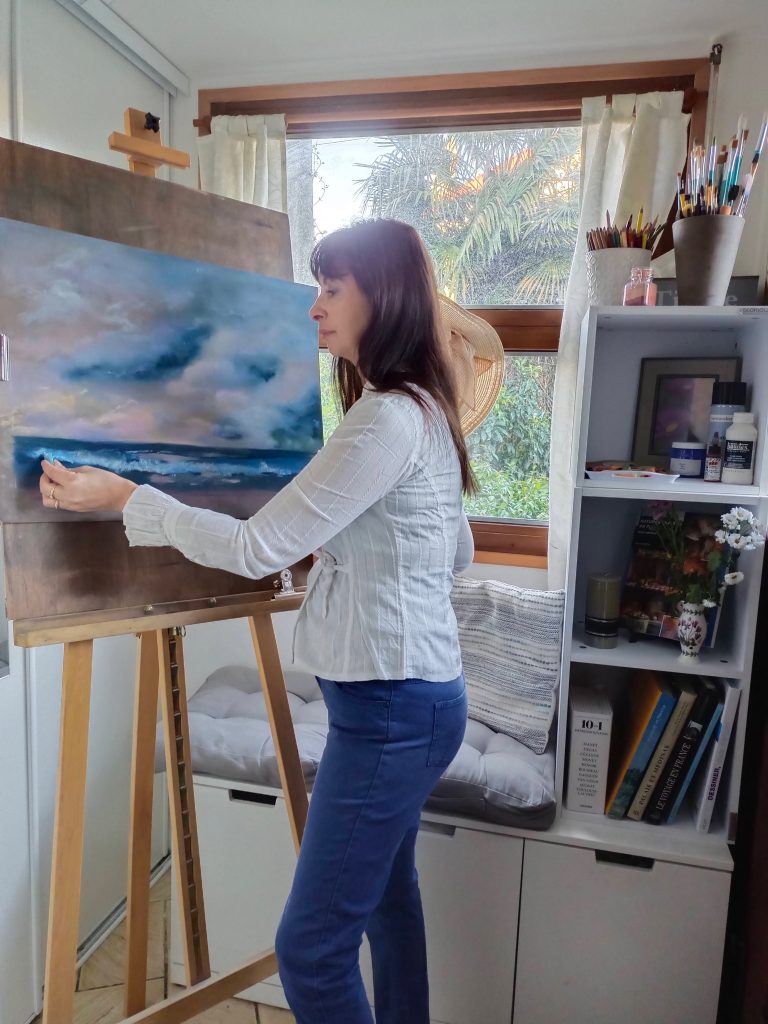
The pleasure of sharing dry pastel:
Introduction: creating is also about sharing
Art holds a special place in my life. I love exploring the possibilities of soft pastels, experimenting with new techniques, discovering materials, and letting the colors tell a story. But beyond the act of creation itself, there is something that is particularly dear to me: sharing.
It is in this spirit that it was born L Art du Pastel by ST, a space dedicated to pastel, to the discovery and exploration of its many possibilities.
Throughout my journey, I wanted to pass on what I had learned, to make this technique accessible and to allow other people to discover the pleasure of creating with pastels.
Organizing workshops and offering training courses has thus become another way to live my passion. Preparing a session, choosing the topics, thinking about the materials and guiding each participant are moments that I particularly enjoy.
But these encounters are never one-sided. While I share my experience and advice, the people who participate in my workshops also bring me a great deal.
To transmit is to explain and to guide, but it is also to listen, observe and learn from others.
It is this human dimension that I want to help you discover here.
1. Dry pastel: a technique to discover and master
Dry pastel is a technique that offers great freedom of expression. Its colors, textures, and the diversity of possible gestures allow for the exploration of very different worlds.
You can work with blending, layering pigments, drawing precise lines, revealing the paper’s grain, or playing with contrasts.
However, when discovering dry pastels, it is not always easy to know where to start.
What paper should I choose? What pastels should I use? How do I create a gradient? How do I work on details or make a color stand out?
These are all questions that one might ask when starting out.
A workshop allows you to gradually discover the characteristics of this technique, to test different gestures and to better understand the possibilities offered by the equipment.
It also allows time to experiment in an environment conducive to discovery, without having to search for all the answers alone.
2. Why I enjoy organizing art workshops and courses
Preparing a workshop is a step that requires thought and organization .
We need to imagine a suitable topic, anticipate the different stages, select the materials and build a progression that allows everyone to advance at their own pace.
I like this preparation because it forces me to think about how I can make a technique more understandable and accessible.
A skill that seems natural to me today sometimes required many attempts to master. Passing it on therefore requires taking a step back from one’s own practice and finding the words to explain what one is doing.
To accompany without imposing
Each person arrives with their own story, desires, experience, and way of looking at the world.
Some are discovering dry pastels for the first time. Others have already practiced drawing or painting and wish to explore a new technique.
The challenge is to provide a framework and guidelines, while still allowing room for each individual’s personality.
I don’t want all the participants to leave with identical works. What interests me is that they can discover the possibilities of pastels, progress, and begin to develop their own artistic sensibility.
The same subject can give rise to very different interpretations. The choices of colours, the way the pigments are applied, the gestures and the details vary from one person to another.
It is precisely this diversity that makes the workshops interesting.
3. A workshop is also a place for exchange and learning
Sometimes we imagine that an art course works in only one direction: the person who teaches transmits their knowledge, while the participants apply it.
In reality, the exchanges are much richer.
Of course, I bring my knowledge, advice, and experience with dry pastels. But I also learn from the people I work with.
Listen to the trainees and understand their expectations
The questions asked during a workshop are often revealing. They allow us to understand what seems simple, what is causing the problem, and the difficulties that we had not necessarily anticipated.
One participant may encounter a problem with color mixing, another may seek to better control their technique or wish to achieve a particular effect.
Their questions lead me to explain differently, to seek a new demonstration or to explore another way of approaching a difficulty.
This listening experience is changing the way I teach and encouraging me to continue learning.
Discover other perspectives
Each participant also brings their own unique perspective.
Some are drawn to bright colors, others prefer soft harmonies. Some observe details with precision, while others work more spontaneously.
These differences are a true asset.
They remind us that artistic creation is not a recipe that can be applied mechanically. It is a personal experience, influenced by our perspective, our sensitivity, and our choices.
I also sometimes discover, through the suggestions of the participants, associations or ideas that I would not have spontaneously thought of.
This is one of the reasons why I consider each workshop to be a shared experience.
4. The pleasure of progressing together, at your own pace
Learning an artistic technique takes time. You have to experiment, observe, start over, and sometimes accept that the result will not immediately match what you imagined.
The workshop helps to demystify this step.
You can ask questions, observe a demonstration, try a technique, compare different approaches and gradually understand what works.
I think it’s important to remember that you do n’t need to have a good level of drawing skills to enjoy discovering dry pastels.
The desire to try and curiosity are already good starting points.
The goal is not to produce a perfect work in a few hours, but to experience a moment of creation, to learn new things and to leave with ideas to continue at home.
Trust is also built through experimentation
When starting out, you may be afraid of making mistakes, choosing the wrong colors, or not being able to reproduce an effect.
However, experimentation is an integral part of the artistic process.
A workshop should also allow one to free oneself from this pressure, to test, to start again and to discover one’s own way of working.
Seeing participants gain confidence, dare more and gradually take ownership of the tools is a particularly rewarding aspect of the transmission.
5. Continue learning, even when you are teaching
Je suis convaincue que lon ne cesse jamais dapprendre lorsque lon pratique une activité artistique.
Les techniques évoluent, le matériel se diversifie, de nouvelles idées apparaissent et notre regard change au fil des expériences.
Préparer des ateliers mamène à revisiter mes connaissances, à approfondir certains points et à chercher de nouvelles façons dexpliquer les choses.
Les échanges avec les participants maident également à identifier de nouveaux sujets à explorer.
Une question peut devenir le point de départ dune prochaine séance. Une difficulté récurrente peut minciter à préparer un exercice plus adapté. Une proposition inattendue peut mouvrir une nouvelle piste de recherche.
Cette dynamique me plaît particulièrement : lenseignement nourrit la pratique artistique, et la pratique artistique enrichit à son tour les ateliers.
Le partage devient ainsi un cercle vertueux dans lequel chacun peut apporter quelque chose.
Conclusion : transmettre, cest aussi recevoir
À travers LArt du Pastel by ST, jai souhaité créer un espace où le pastel sec puisse être découvert, exploré et partagé.
Les ateliers et les stages sont une manière concrète de faire vivre cette envie. Ils permettent de transmettre des techniques, daccompagner des découvertes et dencourager chacun à développer sa sensibilité artistique.
Mais ils représentent aussi bien davantage quun simple apprentissage technique.
Ce sont des moments de rencontre, de curiosité et déchange, pendant lesquels les expériences se croisent et les idées circulent.
Jy apporte mon regard, mes connaissances et mon enthousiasme pour le pastel sec. En retour, les questions, les attentes et les propositions des stagiaires enrichissent ma propre réflexion et me permettent de continuer à progresser.
Je crois profondément que la transmission artistique ne consiste pas seulement à apprendre aux autres à créer. Elle consiste aussi à rester ouvert à ce quils peuvent nous apprendre.
Cest cette réciprocité qui donne tout son sens au partage et qui me donne envie de continuer à faire vivre cet univers créatif.
Merci à toutes les personnes qui ont participé à mes ateliers et à mes stages, pour leur confiance, leur curiosité et les échanges que nous avons partagés.
Et vous, avez-vous déjà participé à un atelier artistique ? Quavez-vous préféré : découvrir une technique, rencontrer dautres passionnés ou simplement prendre le temps de créer ?
Je serais ravie de lire vos expériences en commentaire.
Retrouvez mon univers artistique, mes créations et mes actualités sur LArt du Pastel by ST.