
The complete guide to getting started and progressing
Do you want to learn how to use soft pastels or improve your drawing materials? Choosing the right pastels, pencils, and paper can quickly become complicated given the numerous brands and price differences. However, it’s not necessary to invest in a complete collection to start creating.
After more than ten years of practicing with dry pastels and experimenting with different products available in France and abroad, I share my advice on choosing equipment suited to your level, discovering the main brands of pastel pencils and selecting a support that matches your practice.
Whether you are a beginner, intermediate amateur or experienced pastel artist, this guide will help you gradually build up your equipment, according to your desires, your budget and your artistic sensibility.
1. What materials are needed to start working with dry pastels?
To create your first drawings with soft pastels, three elements are essential: pastel sticks, pastel pencils, and paper. You can then complete your equipment depending on the techniques you wish to explore.
Dry pastel sticks
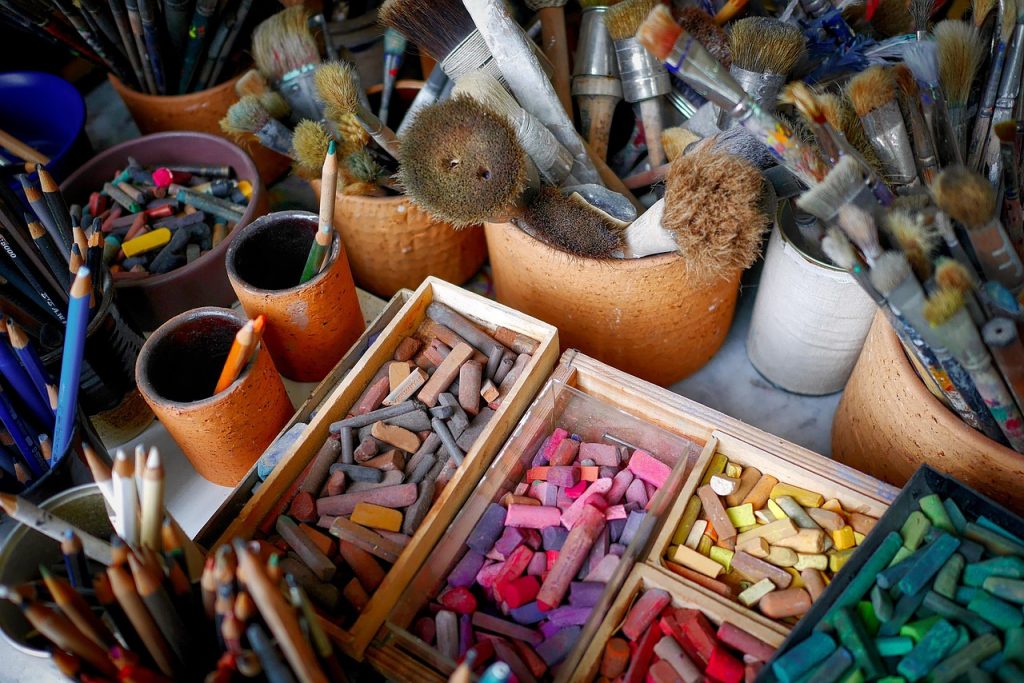
Dry pastel sticks allow you to cover surfaces, work with colors, layer and create textural effects.
There are different textures, from relatively hard to very soft pastels. Their behavior varies depending on the brand and their composition: some are better suited to precise lines, while others facilitate flat washes, blending, and velvety effects.
To begin, opt for a selection of colors varied enough to cover several subjects, rather than immediately buying a large collection.
My advice: Experiment with different textures as you learn. The pastel that suits you best will depend on your working method and the desired result.
Dry pastel pencils
Dry pastel pencils are particularly useful for drawing outlines, adding details and refining certain areas of your artwork.
They are particularly useful for working on small details, fine lines, and color transitions. Their lead should offer a good balance between precision, smoothness, and break resistance.
It’s not essential to have every color from the start. A coherent selection, supplemented as your projects progress, provides a good foundation.
Paper for dry pastels
The paper plays a crucial role in the final result. Its texture, grain, and ability to retain pigments directly influence how the colors are deposited and layered.
For beginners, Canson Mi-Teintes paper is an affordable option that I myself appreciated during my early years of practice. Its price and availability make it a good medium for practicing and experimenting.
With experience, you will be able to try papers specifically designed for dry pastels, including supports with a more textured surface, which allow you to explore other possibilities for layering and rendering.
Key points to remember: The best paper for dry pastels isn’t necessarily the most expensive. Choose it based on your skill level, your technique, and the effect you’re looking for.
2. What materials are needed for dry pastels depending on your skill level?
Your equipment should evolve with your practice. There’s no point in immediately investing in professional equipment if you’re still discovering the possibilities of this technique.
Beginner level: learn and experiment
When you start with dry pastels, the goal is to understand how the pigments react to the paper, how to mix colors, and how to gradually build up a drawing.
I recommend that you prioritize:
- A reasonable assortment of dry pastel sticks.
- A few pastel pencils for outlines and details.
- Affordable paper, like Canson Mi-Teintes.
- A selection of colours suited to the subjects you like to draw.
At this stage, it is better to dedicate part of your budget to practice rather than accumulating supplies.
Intermediate level: diversifying your tools
After several months of practice, you will probably have identified the tools that suit you and the limitations of your initial equipment.
This is a good time to experiment with new brands of pastel pencils, compare different stick textures, and test other papers.
Changing the medium can transform the way you work. Some papers allow for more layering, while others produce a different result from the very first strokes.
I advise you to conduct your tests on small formats before choosing a new medium for a major work.
Advanced level: refining your technique
With several years of experience, the choice of materials becomes more personal. You may look for a specific texture, a particular pigmentation, or a support suited to your way of building up color layers.
In my artistic journey, after about five years of practice, I felt the need to experiment with other mediums. This change was also accompanied by an evolution in my choice of pastel sticks.
This step does not necessarily involve buying more, but rather selecting tools that meet specific artistic needs.
3. What are the best dry pastel pencils?
There is no single brand that is universally better than all others. The choice depends on the texture of the lead, the pigmentation, the ease of blending, the desired precision, and the comfort of use.
Here are several brands to discover to find the dry pastel pencils that suit you.
Faber-Castell Pitt
Faber-Castell Pitt pastel pencils offer a wide range of colours and are appreciated for their use in precision work.
They may be suitable for artists who wish to refine details and complement their work with pastel sticks.
Caran d’Ache
The Swiss brand Caran d’Ache offers pastel pencils renowned for their pigmentation and blendability.
They may be of interest to pastel artists who are looking for expressive color and good flexibility of use.
Derwent
Derwent pastel pencils are prized for their smoothness and ease of use. Their range of colors allows for the exploration of different shades and the creation of transitions.
Their ease of handling is also a factor to consider if you spend a lot of time drawing.
Koh-I-Noor Toison d’Or
Koh-I-Noor Toison d’Or pastel pencils are another range worth exploring. Their pigmentation and texture are suitable for layering colors and working with shades.
As with other brands, it’s best to test a few pencils before investing in a full set.
Told in Paris
Conté à Paris is a historic brand of art supplies that also deserves your attention. Its pastel pencils can be used for working on details, nuances, and textural effects.
Their usefulness will depend in particular on the texture you are looking for and your drawing style.
My favorite pastel pencils: CarbOthello
Of the pencils I’ve had the opportunity to use, CarbOthello are among my favorites.
This choice is linked to my personal experience: the best pencil is the one with which you get the desired result and feel comfortable working.
I continue to discover and test other brands. I will share my new impressions as I experiment.
My advice: Before buying a whole set, try out a few pencils from different brands. You can compare their performance, precision, and how they work on your usual paper.
4. Where can I buy supplies for dry pastels?
To buy your pastels, pencils and papers, you can turn to fine art stores or specialized online shops.
Here are two brands that I mentioned in my previous recommendations:
- The Giant of Fine Arts : to discover a selection of art supplies.
- Jackson’s Art Supplies : a specialist shop offering equipment for various artistic techniques.
Before ordering, compare product references, dimensions, color assortments, delivery costs, and return conditions.
Also remember to check that the product chosen is suitable for your technique: a dry pastel pencil and a classic colored pencil are not interchangeable.
5. How to assemble your equipment without spending too much?
Dry pastels offer many possibilities, but the price of some products can represent an investment, particularly when starting out.
To avoid unnecessary purchases, here are a few simple principles:
1. Start with the essentials. Choose some pastel sticks, pencils for details and paper suitable for your first attempts.
2. Buy according to your topics. If you enjoy drawing portraits, landscapes, or still lifes, gradually adapt your palette to the colors you actually need.
3. Test before renewing your equipment. A particular paper or brand of pastel may appeal to you in theory without actually corresponding to your way of working.
4. Upgrade your equipment with your experience. You will be able to invest in more specific products once you have identified the textures and surfaces you prefer.
5. Keep track of your attempts. Note the brand of pastel, the type of paper, and the color combinations you like. These observations will help you make more informed choices.
6. Can dry pastel be combined with other techniques?
Dry pastels can also be used in mixed media techniques. Combining them with watercolor, for example, allows for the exploration of other visual effects and the variation of textures.
This approach, however, requires careful consideration of the choice of support and the order in which the media are applied. The paper must be suitable for the technique used beforehand, particularly when it will be wetted.
To delve deeper into this topic, check out my article: Watercolor and dry pastel: an artistic combination.
Experimentation is an excellent way to better understand the possibilities of dry pastels and to develop your own artistic language.
Conclusion: the best materials for soft pastels are those that suit you best.
Choosing your materials for dry pastels is a gradual process. Pastel sticks, pencils, and paper should be selected according to your skill level, budget, and artistic goals.
To get started, simple and affordable equipment is more than enough to learn the basics. With practice, you can explore new brands, compare equipment, and refine your preferences.
For me, Canson Mi-Teintes was one of my preferred materials when I started out, and CarbOthello pencils remain among my favorites. But every artist develops their own habits: it’s through experimentation that you’ll discover the tools best suited to your creativity.
And you, what is your favorite material for painting with dry pastels? Do you have a particular brand of pencils, sticks, or paper that you highly recommend?
Share your experience in the comments: your advice could help other artists make their first choices.
You can also find my inspirations, tips and experiments with dry pastels on L’Art du Pastel by ST.